
The Education System In Canada In 2026: From Daycare To University For New Permanent Residents
Any conversation about settling in Canada cannot ignore one of the most frequent questions among families and young people arriving as permanent residents: how does the education system work? What options exist for children? Are there costs to anticipate? And what about adults who want to continue studying or have their credentials recognized?
The education system is one of Canada's greatest attractions as an immigration destination. But as with the cost of living, there is no single answer. Rules, costs, programs and services vary by province, level of education and the profile of the person arriving.
That is why this article does not aim to provide a simplified summary. It aims to offer a real and useful framework for those planning their arrival or who have just landed as permanent residents.
Why does the education system matter from day one?
For many families, the education system is not a topic they can put off. From the moment they land, they need to know where to enroll their children, what documents to present, what to expect from the first school year and whether there are associated costs.
For adults arriving alone or as a couple, the education system also matters, but in a different way: can they study while working? Can they have their credentials recognized? Do they have access to language programs or professional training?
The Government of Canada recognizes that education is one of the most important settlement areas for new permanent residents, and its settlement and pre-arrival services include specific guidance on the provincial education system.
How is the education system in Canada organized?
The Canadian education system is organized primarily by provinces and territories, not the federal government. That means each province has its own ministry of education, its own enrollment rules, its own school calendar and its own policies on the language of instruction and support programs for newcomers.
In general terms, the education system in Canada can be understood in four broad stages:
Early childhood care and education (daycare and kindergarten)
Primary and secondary education (K-12, from kindergarten to grade 12)
Post-secondary education (colleges, technical institutes, universities)
Continuing education and adult programs
Each stage has different implications for newcomers, both in terms of access and costs.
Childcare and early education: a priority that has changed in recent years

For families with young children, childcare (daycare) is often one of the first questions when arriving in Canada. And here there is important news: the landscape has changed significantly in recent years thanks to the federal low-cost childcare program introduced by the Government of Canada.
The goal of the national childcare program is to reduce the average cost to CAD 10 per day for most families across the country. Implementation progress varies by province, but most provinces and territories have signed agreements with the federal government to work toward that goal.
This is relevant for newcomers because childcare in Canada has historically been one of the highest expenses for families. In provinces like Ontario or British Columbia, a daycare spot could cost between CAD 1,500 and CAD 2,500 per month per child before the federal program. With the progressive implementation of fee reductions, many families are seeing significantly lower costs, although access to available spots remains a challenge in many cities.
Kindergarten (generally for children aged 4 to 5) is part of the public education system in most provinces and is free. In Ontario, for example, the Full-Day Kindergarten program offers a full day for children aged 4 and 5 at no additional cost.
For newcomers with preschool-aged children, the practical recommendation is to contact the local school board or provincial ministry of education as soon as possible, as waitlists for childcare spots can be long in urban areas.
Primary and secondary education (K-12): free and mandatory for permanent residents

One of the clearest advantages of the Canadian education system for newcomers is that primary and secondary education in public schools is free for permanent residents. That includes from kindergarten through grade 12, which corresponds roughly to ages 5 or 6 through 17 or 18, depending on the province.
Permanent residents have the same right of access to public schools as Canadian citizens. There is no difference in cost. The Government of Canada confirms that children who are permanent residents have the right to attend government-funded public schools in their province. (canada.ca)
The enrollment process varies by province and school board, but generally requires:
Proof of residence in the area (rental agreement, utility bill, etc.)
Proof of immigration status (permanent resident document)
Previous school records from the country of origin, if available
Vaccination records, in many cases
Many school boards in cities with high concentrations of immigrants have welcome or reception programs for newcomer students, which include an assessment of English or French proficiency and support during the transition. In Toronto, for example, the Toronto District School Board (TDSB) operates Newcomer Reception Centres specifically to guide newly arrived families.
The language of instruction: English, French or both

One of the most frequent questions from families upon arrival is: in what language will my children study?
In most provinces outside Quebec, the main language of instruction in public schools is English. However, in all provinces there are also French-language education options (known as écoles francophones) for families who qualify, generally those with minority language rights under the Canadian Charter of Rights and Freedoms.
In addition, in almost all provinces there are French Immersion programs, which allow any student to receive part or most of their education in French, even if French is not the home language. These programs are very popular among immigrant families who want their children to be bilingual.
In Quebec, the main language of instruction in public schools is French. Children of permanent residents who settle in Quebec will generally attend French-language schools, unless specific English-language education rights exist under the Charter.
For students who arrive without knowledge of the language of instruction, most school boards offer English as a Second Language (ESL) or French as a Second Language support programs. These programs are integrated into the school system and are free.
Do support services vary by province?
Yes, and this is one of the most important differences newcomers need to understand. The level of support for newcomer students varies significantly by province and school board.
Provinces with a historically high concentration of immigrants, such as Ontario and British Columbia, have more developed support systems, with more resources available in multiple languages and specific programs for recently arrived students. Smaller provinces or those with lower immigration flows may have more limited resources, although some Atlantic provinces have actively invested in educational settlement services in recent years as part of their immigrant retention strategies.
This does not mean one province is automatically better than another for families with school-aged children. It means it is worth researching the services available in the specific school board where they plan to live, not just in the province in general.
Federally funded settlement services can also help families connect with local educational support once they arrive. (canada.ca)
Post-secondary education: colleges, technical institutes and universities

For young adults and for those arriving with university-aged children, the Canadian post-secondary system is one of the most recognized in the world. But it is also important to understand how access works for permanent residents.
The good news is that permanent residents generally pay domestic tuition rates, which are significantly lower than the international rates paid by students on study visas. That represents a very real and concrete difference in the total cost of studying in Canada.
The Canadian post-secondary system is divided mainly into:
Universities: Offering undergraduate, master's and doctoral programs. Costs vary by province and institution. In general terms, annual undergraduate tuition for domestic students ranges from approximately CAD 6,000 to CAD 15,000 depending on the program and institution, although some regulated professions such as medicine or law may have significantly higher costs.
Colleges of Applied Arts and Technology: These are post-secondary institutions offering diploma and certificate programs, generally two or three years long, in technical, business, health, technology and arts fields. They are a very popular option for newcomers because they combine practical training with relatively quick access to the labor market. Costs are also generally lower than those of universities.
Technical and vocational institutes: Offer shorter and more specific training oriented directly toward employment. In many provinces, these programs are aligned with certifications recognized by specific industries.
Recognition of foreign credentials: a reality adults must plan for
One of the most important topics for adults arriving in Canada with university or technical education from abroad is the recognition of their credentials. This process can be longer and more complex than many anticipate, and it is important to approach it with realistic expectations.
In Canada, the recognition of foreign credentials varies by profession and province. For regulated professions such as medicine, nursing, engineering, law, accounting or teaching, the recognition process is managed by provincial regulatory bodies, not the federal government. That means requirements may differ from one province to another, even for the same profession.
The Government of Canada offers specific resources to help newcomers understand how credential recognition works in their professional field and province. Bridging programs also exist in many provinces, designed to help foreign-trained professionals complete the additional requirements needed to practice in Canada. (canada.ca)
For non-regulated professions, the process is generally more flexible, although Canadian employers may request educational equivalency assessments from recognized organizations such as World Education Services (WES). This assessment, while it has a cost, is frequently requested by employers and may also be required in some university admission processes.
The practical recommendation is to start researching credential recognition requirements before arriving, if possible, as the process can take time and should not be underestimated.
Language programs for adults: a fundamental gateway
For many newly arrived adults, the first step in the Canadian education system is not a university or technical program, but a language program. And here too there is good news.
The Government of Canada funds free English and French programs for eligible adult newcomers. The LINC program (Language Instruction for Newcomers to Canada) offers free English classes for adult permanent residents. The French equivalent is CLIC (Cours de langue pour les immigrants au Canada). (canada.ca)
These programs are not just language classes. Many include practical components with guidance on life in Canada, the health system, the labor market and residents' rights. They are a very valuable entry point, especially in the first months.
In addition to LINC and CLIC, many provinces have their own language training programs or supplement the federal programs with additional resources.
Education and choice of province: does it matter for families?
As with the cost of living, the question of education also has a provincial dimension that families must consider. It is not just about whether the system is good in general, but about how accessible specific resources are in the place where they plan to live.
Quick overview by family profile and education
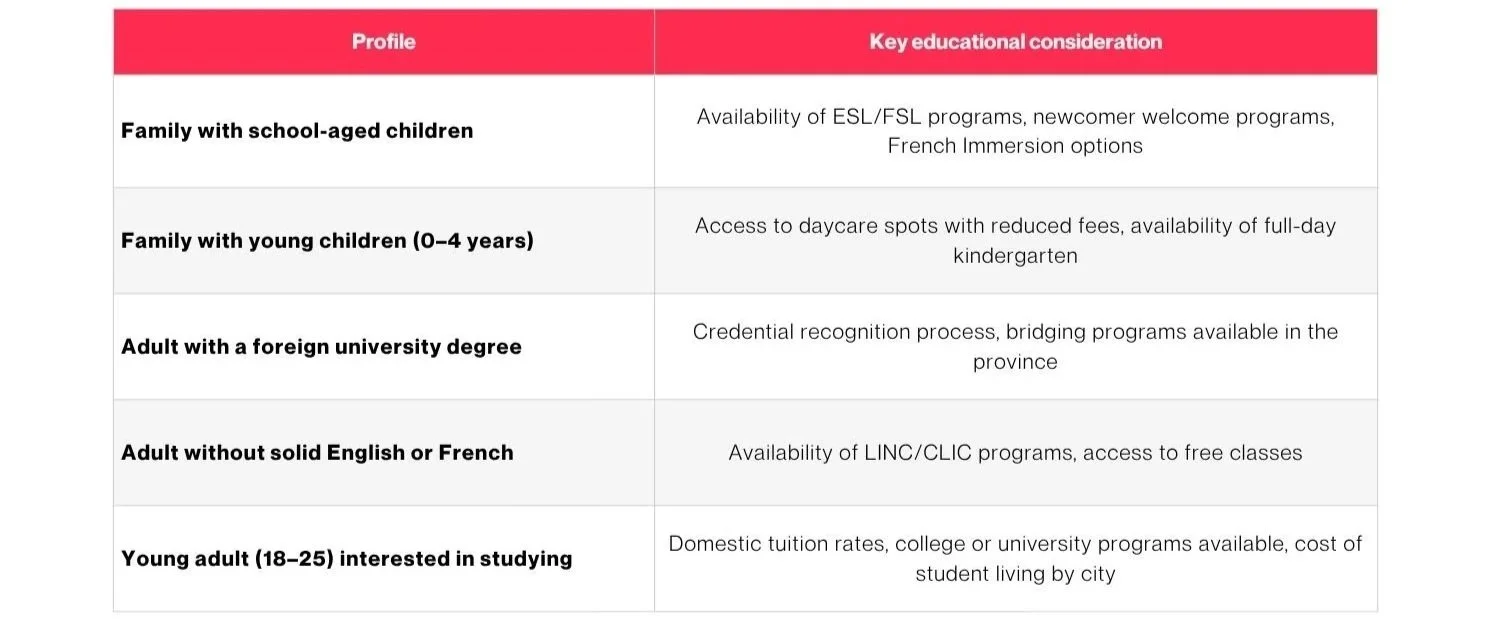
This table is not intended to be exhaustive, but it illustrates why the conversation about education cannot be separated from the decision about where to live.
What happens to children who arrive in the middle of the school year?
This is a practical question many families have and one that sometimes does not appear in general resources. The answer is that in most cases, students can be enrolled at any point in the school year, not just in September.
School boards in Canada are accustomed to receiving students at different times of the year, especially in cities with a constant flow of immigration. The process may require an initial assessment of the student's level to place them in the appropriate grade and support, but in general there are no formal barriers to enrollment outside the start of the school year.
The practical recommendation is to contact the school board in the area where they plan to live as soon as possible, ideally before landing if they already know where they will settle, to understand the timelines and required documents.
The education system as part of the settlement plan, not a separate topic

One of the most important reflections in this article is that the education system should not be thought of as a topic separate from the settlement process. For families, access to good schools, the availability of language programs and the existence of affordable childcare are factors that can directly influence the choice of province, city and neighborhood.
For adults, access to credential recognition programs or additional technical training can be part of the strategy to integrate into the labor market as quickly and solidly as possible.
IRCC's settlement and pre-arrival services are designed precisely to help newcomers plan these areas before landing and to connect with support once in Canada. They are free, available online and cover topics ranging from education to employment, housing and health. (canada.ca)
The education system in Canada in 2026 is one of the strongest assets the country offers to those arriving as permanent residents. Primary and secondary education is free. Language programs for adults are accessible. Childcare is in the process of transformation toward a more affordable model. And post-secondary options are broad for those who want to continue studying or redirect their career.
But as with so many aspects of life in Canada, the details matter. Services vary by province. Credential recognition can be more complex than expected. And the choice of where to live can have a direct impact on how easy or difficult it is to access the right educational resources for each family profile.
That is why understanding the Canadian education system before arriving is not a luxury. It is part of serious immigration planning.
At Global Opportunities, we always recommend starting with the appropriate legal immigration assessment, because the first step is understanding which immigration programs your profile is best positioned for and which pathways are truly viable for you. Once that is clear, there is room to plan in depth the settlement aspects, including your children's education, the recognition of your credentials and the training options available in the province where you plan to settle.
Good planning is not just about arriving in Canada. It is about arriving prepared to build from day one. And for that, an assessment with Global Opportunities is always available.